Hello, this is Haewol, your dedicated Quality Expert.
Summer is now in full swing. While the southern regions are seeing rainfall, the Gyeonggi and Chungcheong provinces are baking under a scorching sun. Today, I would like to introduce the EREV (Extended Range Electric Vehicle)—a technology powering the very vehicles our company is currently developing products for. This vehicle project is actively being pushed forward at Hyundai Motor Group’s Metaplant in Savannah, Georgia.
As the global automotive industry navigates the current EV "Chasm" (a temporary stagnation in demand), Hyundai Motor Group is preparing a core weapon to break through this slowdown across its global manufacturing hubs, including Hyundai Motor Group Metaplant America (HMGMA) in Georgia. That weapon is EREV (Extended Range Electric Vehicle) technology.
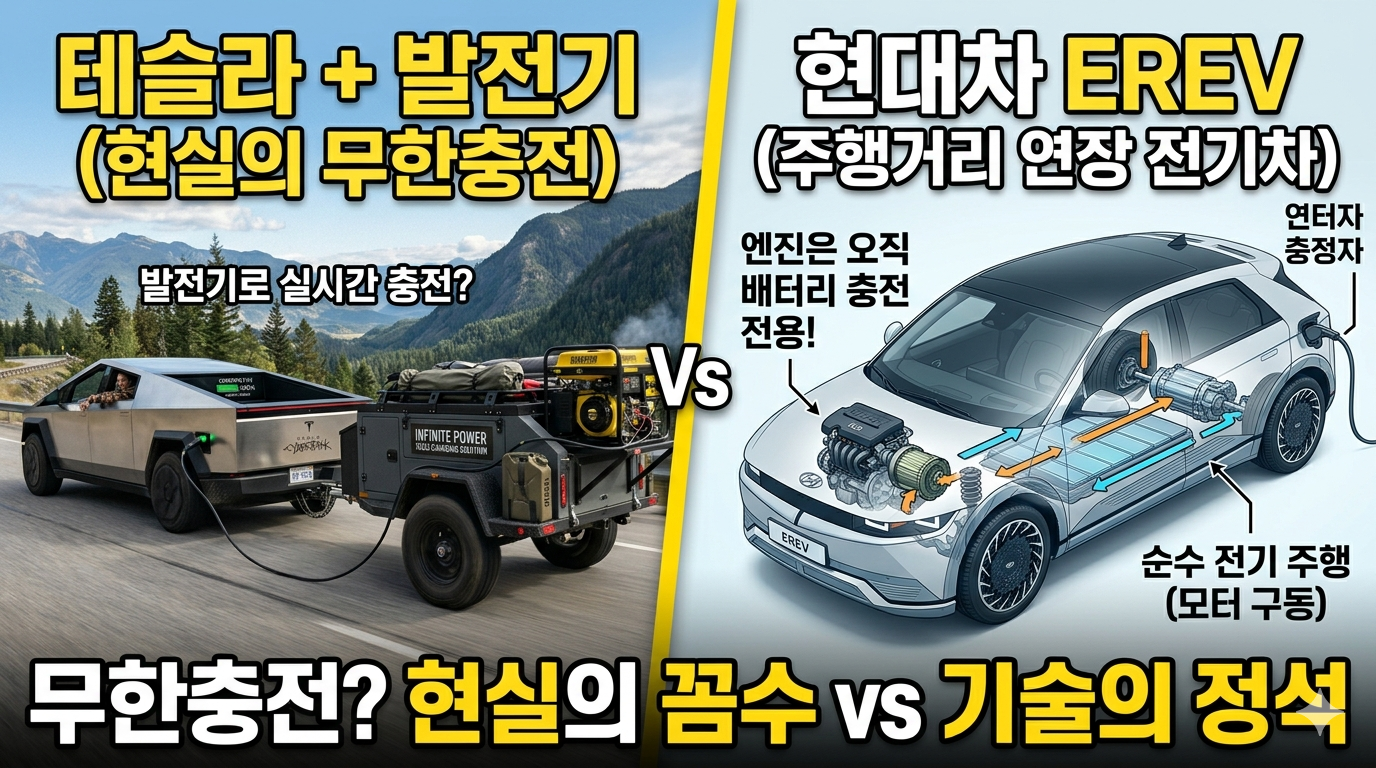
Capable of traveling over 600 miles (approximately 965 km—and reportedly reaching up to 1,000 km during actual development testing) on a single full charge and tank of gas, this technology is hailed as a tailor-made solution for the North American market, where long-distance cross-country travel is common and charging infrastructure remains insufficient. Based on the core concept that "fossil fuel is used exclusively to charge the battery," let’s take a deep dive into the operating principles of EREVs, how they differ from Plug-in Hybrids (PHEVs), and their distinct technical advantages.
1. Definition and Core Operating Principles of EREVs
Structurally, an EREV is a pure battery electric vehicle (BEV) integrated with an internal combustion engine (ICE) and an electric generator. The physical driveshaft that turns the wheels is connected solely to the electric motor. The onboard engine has absolutely zero involvement (0%) in direct mechanical propulsion.
- Battery-First Propulsion (EV Mode): When the battery has sufficient state of charge (SoC), the vehicle runs entirely on electric energy charged from external sources. It delivers the exact same quietness and instantaneous acceleration as a pure BEV.
- Engine as an Onboard Generator (Charge Sustaining Mode): When the battery drops below a predetermined threshold (e.g., 15% to 20%) during driving, a compact internal gasoline engine automatically fires up. Instead of turning the wheels, this engine drives a generator to produce electricity. This power is then routed through an inverter to either charge the battery or supply electricity directly to the drive motor.
2. Technical Comparison: EREV vs. PHEV (Plug-in Hybrid)
Because both technologies utilize a battery, a motor, and an engine, they are easily confused. However, their underlying powertrain topologies are fundamentally opposite.
| Category | EREV (Extended Range Electric Vehicle) | PHEV (Plug-in Hybrid Electric Vehicle) |
| Powertrain Topology | Series Hybrid Base Only the electric motor drives the wheels. |
Parallel / Series-Parallel Base The engine and motor drive the wheels simultaneously or alternately. |
| Role of the Engine | Dedicated Power Generation (On-board Generator) Mechanically completely decoupled from the driveshaft. |
Dual Role (Propulsion + Generation) The engine directly drives the wheels during high-speed cruising. |
| Driving Dynamics | Maintains a 100% EV torque profile regardless of remaining battery capacity. | Transitions to an ICE-like driving feel when the battery is depleted or during hard acceleration. |
| Transmission | None (Only a single-speed EV reduction gear is required). | Required (Needs an engine transmission and a power-split device). |
3. Technical Advantages and Engineering Innovations
① Battery Optimization and Cost Reduction
To achieve a range of over 900 km with a pure battery electric vehicle (BEV), a massive, heavy battery pack of around 100 to 130 kWh is required, which drastically inflates the vehicle's retail price. In contrast, an EREV reduces battery capacity by about 30% to 40% compared to an equivalent BEV (utilizing a tighter 30 to 40 kWh pack instead), substituting the saved space and weight with a compact engine and fuel tank. This lighter curb weight improves overall electrical efficiency, and by down-sizing the battery—the most expensive component in an EV—the vehicle secures a powerful price competitiveness.
② Ultra-High Engine Efficiency (Fixed Optimal Operating Point)
Engines in conventional ICE vehicles or PHEVs must constantly vary their RPM to adapt to ever-changing road conditions, such as urban traffic jams, sudden acceleration, and high-speed highway cruising. This variance severely degrades thermal efficiency.
An EREV engine, however, only needs to spin the generator. Therefore, it can operate at a fixed, highly optimized RPM range (Optimal Operating Point) where the engine extracts the maximum amount of electricity from the minimum amount of fuel. Consequently, even a small-displacement engine can achieve maximized fuel economy and outstanding generation efficiency.
③ Elimination of Charging Stress and Cold-Weather Range Anxiety
When winter temperatures drop, the driving range of standard EVs typically plummets by 20% to 30% due to battery chemistry limitations. An EREV completely resolves this "dependency on charging infrastructure" and "range anxiety"—the primary pain points of pure EVs. Even if battery performance degrades or a driver finds themselves in remote areas devoid of charging stations, they can simply fill up with gasoline at any standard gas station to self-generate the required electrical power.
4. Strategic Value for HMGMA and Hyundai Motor Company
Hyundai Motor Group plans to mature this proprietary EREV powertrain technology and kick-start full-scale mass production around late 2026 to early 2027 at its North American production strongholds, including the Georgia Metaplant (HMGMA) and the Alabama plant. The technology is slated to debut on mid-size and medium SUV lineups favored by North American consumers, such as the Genesis GV70 and the Hyundai Santa Fe.
From a manufacturing perspective, the system boasts a simpler architecture than the existing TMED hybrid system. This makes it highly advantageous for mixed-model production within a dedicated EV smart factory like HMGMA without requiring massive assembly line overhauls. It also leaves the automaker relatively shielded from large-scale battery supply bottlenecks—a massive plus for manufacturing operations. Leading automotive analysts project that EREVs will transcend being a mere transitional technology, evolving instead into a highly practical and dominant market platform bridging pure EVs and ICE vehicles for decades to come.
The only disappointing note is that we will likely have to wait a bit longer for this technology to be commercialized in the domestic Korean market. It is truly a revolutionary technology that could handle a round trip from Seoul to Busan on a single fill-up. My hope is that once it completes its "beta testing" in the US market and establishes its technical credentials, it will be introduced to domestic models to offer a powerful solution in this era of high oil prices.
'품질관리' 카테고리의 다른 글
| 품질관리-미국 출장 필수 체크리스트: I-94(입국 기록) 조회 및 완벽 관리법 (1) | 2026.06.25 |
|---|---|
| 무한동력 - 장거리 주행을 현실로 EREV 프로젝트 (0) | 2026.06.24 |
| 품질경영 - 부적합 8D 문제 해결 방법론 (0) | 2026.06.22 |
| 품질경영-ISO 37001 부패방지(ABMS) 인증 심사 준비 및 마스터 목차 가이드 (0) | 2026.06.21 |
| 품질경영-MSA / Gage R&R의 통계적 메커니즘과 현업 적용 가이드 (0) | 2026.06.20 |


