ISO Auditor Certification: The Reality Behind the Ideal
When reviewing resumes through recruitment or headhunting, many are packed with titles like "ISO Auditor," "International Auditor," or "Audit Correspondent." At first glance, one might think, "How did such a talented individual apply here?" However, after interviewing them, it turns out that 95 out of 100 are merely chasing an ideal or adding a single line to their resume. Most have only knocked on the door of an "Associate Auditor" (Intern) level, rather than becoming a true Auditor.
ISO 9001, 45001, 14001, 37001, 27001... there are countless ISO standards and just as many auditors in the field.
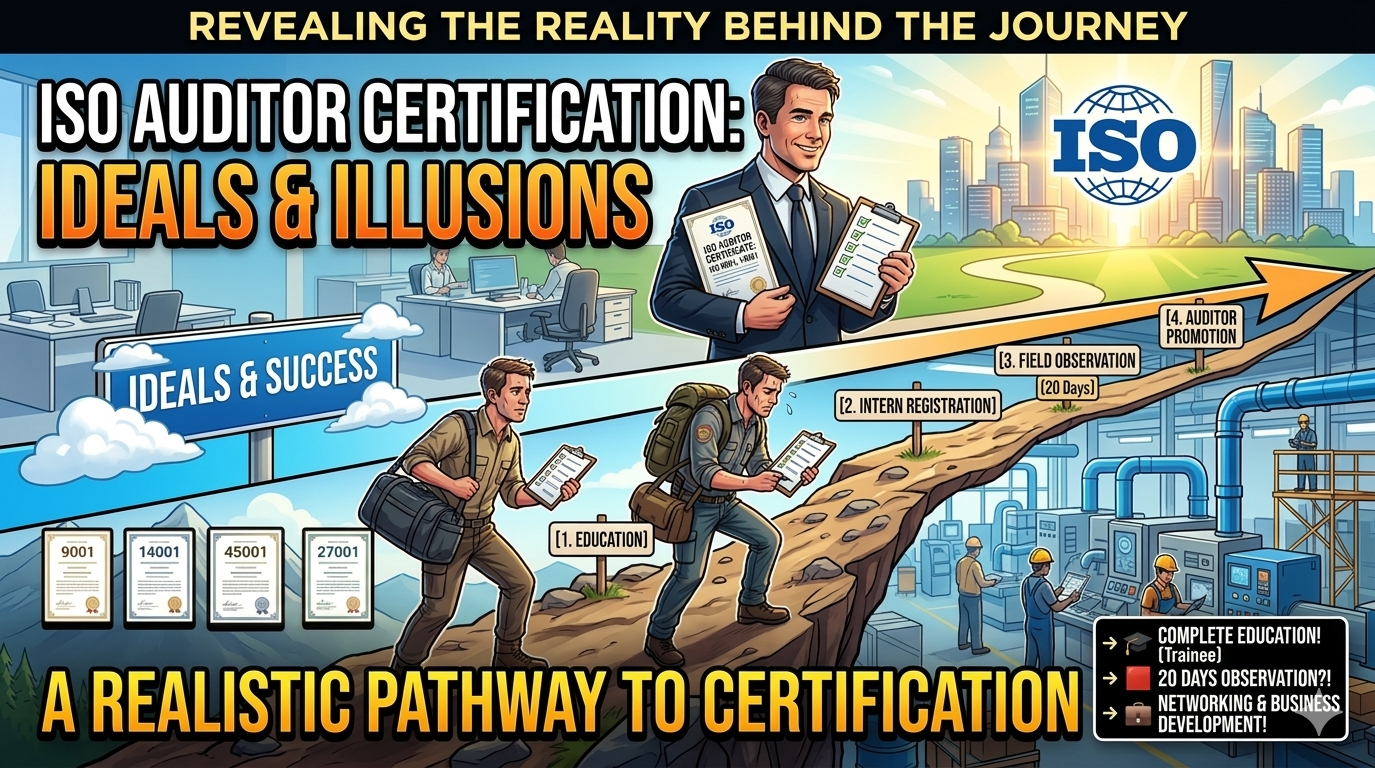
Becoming a certified auditor is a journey that requires "strategic networking" and "patience" far beyond simply completing a course. By analyzing numerous success stories and realistic failure cases found online, I want to explain the "ideals vs. illusions" of the [Real-World ISO Auditor Qualification Process] for those preparing for a second career as a quality expert. What is the truth behind the marketing? You must face the reality that the "International Auditor" training courses advertised on various portal cafes are often just profit-making ventures for associations and certification bodies. They are not necessarily there to create opportunities for you!
1. Process Roadmap Summary
| Stage | Key Activities | Core Barrier (Realistic Obstacles) |
| Stage 1. Training | 40-hour course at institutions (KSA, KPC, etc.) | Passing the Exam: Ability to interpret requirements is key, not just memorization. |
| Stage 2. Registration | Register as an Associate Auditor (Intern) | Proof of Qualification: Documentation of career history and quality-related experience. |
| Stage 3. Witness Audits | 20+ days of on-site audit observation | Networking Battle: The hardest hurdle—finding a lead auditor to take you along. |
| Stage 4. Promotion | Register as a Full Auditor | Verification: Final review of professional experience and audit observation reports. |
2. Detailed Analysis & Realistic Advice
[Step 1] Training & Examination (The Knowledge)
- The Reality: Training fees at major institutions like the KSA or KPC are high, ranging from 800,000 to 1,000,000 KRW. After 5 days of intensive training, you take an exam. While various "shortcut" or "compressed" courses exist, remember that these are only the foundation for becoming an Associate Auditor, not a lead auditor.
- Advice: Exams are often open-book, but time is extremely tight. You shouldn't be "searching for answers" but rather "instantly knowing where the requirement is located" in the standard. Focus on practical exercises (like writing Non-Conformity Reports, NCR) emphasized by instructors.
[Step 2] Associate Auditor Registration (The Qualification) – Not yet an Auditor
- The Reality: A certificate of passing the exam alone achieves nothing. You must pay a registration fee to bodies like KAR (Korea Authority of Registration) to receive your "Associate Auditor" card.
- Advice: Required experience varies by education level. Check your documents in advance to ensure your career history proves your involvement in "Quality" or "Management Systems."
[Step 3] 20 Days of Witness Audits (The Hardship – The Biggest Hurdle)
- The Reality: This is where most people give up. Lead auditors are often reluctant to bring a total stranger (the Associate) to their audit sites due to security concerns, fee distribution, and the burden of training.
- Strategic Approach:
- Leverage Current Position: During your current company's surveillance audit, build a rapport with the visiting auditor and politely ask for a mentorship opportunity.
- Join a Certification Body: Entering a small certification body as an intern to assist with administrative tasks can be the fastest way to get observation opportunities.
- Peer Network: Actively network with fellow trainees who might have connections to certification bodies.
[Step 4] Promotion and Career (The Career)
- The Reality: Even after becoming a full auditor, you usually start as a freelancer. Income is generated based on assigned Man-Days (M/D). Without sales ability, opportunities will not come. Many end up doing consulting alongside auditing, which also requires sales.
- Advice: ISO 9001 alone is not competitive. You must expand into 45001 (Safety), 27001 (Information Security), 37001 (Anti-bribery), 14001 (Environment), and IATF 16949 (Automotive). Realize that your current network may not guarantee business after you leave your position. You must secure a senior mentor who can guide you from report writing to leading an audit.
3. Expert's One-Line Report
"Becoming an ISO Auditor is not about earning a 'certificate'; it is about proving your 'competence.' The 20-day witness period is not just for filling dates—it is an 'apprenticeship' where you learn from various corporate processes to establish your own auditing philosophy. Face the reality that your own proactive sales ability is the top priority, and developing that skill is the ultimate key to success."
'품질관리' 카테고리의 다른 글
| 품질삼매경-실전 ISO 경영관리: 방침 수립부터 경영검토까지의 실행 요령 (0) | 2026.05.31 |
|---|---|
| 품질삼매경-이슈와 리스크 SWOT (0) | 2026.05.30 |
| 품질경영-자동차 품질 업무 기본용어 (0) | 2026.05.28 |
| 품질경영-자동차 업무 전문 용어 (영어, 한글본, 중국어본) (0) | 2026.05.27 |
| 품질경영-시정(Correction),시정조치(Corrective Action),예방조치(Preventive Action) (0) | 2026.05.26 |
